
Choosing a BLS card is mostly a question of who has to accept it. This list is for nurses, EMTs, dental staff, and nursing or allied-health students who need a Basic Life Support credential that an employer, school, or licensing body will honor. The options were chosen for employer acceptance, alignment with current American Heart Association (AHA) guidelines, format flexibility, and transparency about price and renewal.
Quick Comparison of the BLS Options
- Midwest CPR Center: best for Midwest clinicians and employers wanting local, in-person BLS; pricing on the website; covers BLS, CPR, First Aid, and AED for whole staff teams from one provider.
- American Heart Association BLS Provider Course: best for clinicians whose employer names AHA; price set by each Training Center; the broadest acceptance in hospital job requirements.
- AHA HeartCode BLS: best for shift workers renewing AHA BLS; online fee plus a separate skills session fee; a self-paced online portion that shortens classroom time.
- American Red Cross Basic Life Support: best for learners whose employer accepts Red Cross credentials; see website for pricing; a large national network with frequent class times.
- ASHI BLS: best for small practices training whole teams on site; price varies by provider; flexible on-site group delivery popular with dental offices.
- National Safety Council BLS: best for employers consolidating safety and BLS training; see website for pricing; bundles with broader occupational safety programs.
- Military Training Network (MTN): best for staff of affiliated agencies or programs; price varies by site; training delivered inside affiliated organizations rather than open enrollment.
1. Midwest CPR Center
Midwest CPR Center is a Midwest-based provider of instructor-led BLS, CPR, First Aid, and AED training for healthcare workers and the employers who staff them. It is built for clinicians who want to practice with a certified instructor rather than a screen, and for managers who would rather book one provider for several course types.
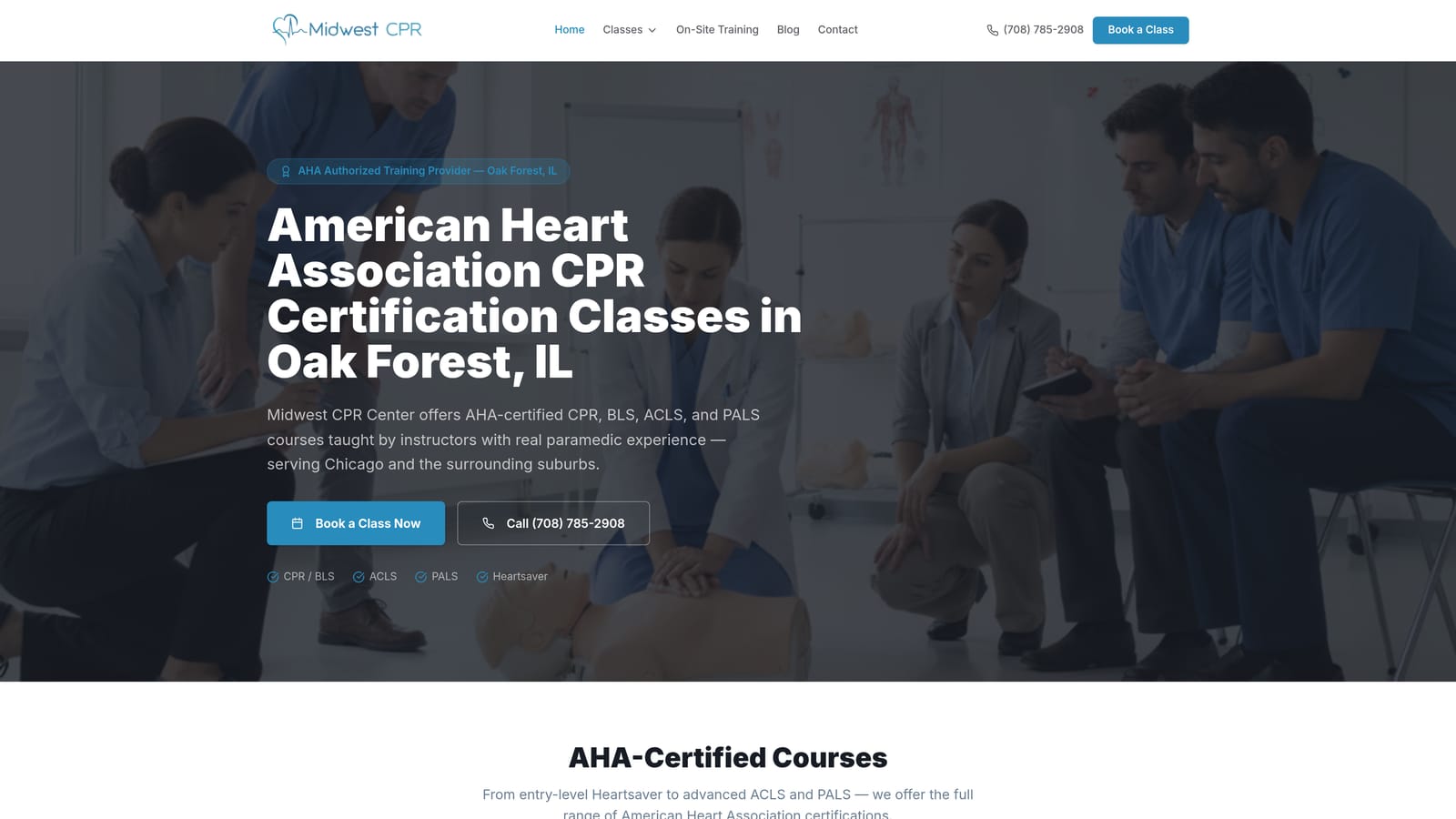
Its distinguishing strength on this list is breadth within a single regional provider. A clinic or practice can train staff in BLS, then add First Aid and AED courses for front-desk and support employees without juggling vendors. Hands-on practice is the core of the format, which matters because skills verification is what most employers care about.
- BLS certification for healthcare providers, covering the team-based, bag-mask, and AED skills that separate BLS from layperson CPR.
- Hands-on skills practice with certified instructors, so you get feedback on compressions and ventilations in real time.
- CPR, First Aid, and AED courses in one place, which simplifies scheduling for mixed clinical and non-clinical staff.
- Healthcare provider training programs for employers who need to certify groups and keep renewals organized.
Setup is simple: individuals enroll in a class, and employers arrange group training and pair BLS with First Aid and AED courses. The main limitation is geography. The provider is regional, so it is a poor fit if you live or work outside the Midwest. As with any provider, confirm which issuing organization's card your employer requires before you book, since some hospitals name AHA specifically.
Pricing: see the website for current course fees. Group and employer training is typically priced differently from individual enrollment, so ask about team size when requesting a quote.
Best for: Midwest clinicians and employers wanting local in-person BLS.
2. American Heart Association BLS Provider Course
The American Heart Association BLS Provider Course is the standard most often named in hospital job postings and clinical program requirements. It is taught through authorized Training Centers and instructors, and it is designed for nurses, physicians, EMTs, respiratory therapists, and students entering clinical rotations.
What it does best is remove doubt. If a hiring manager says "BLS," an AHA card rarely prompts a follow-up question. The curriculum follows current AHA guidelines and emphasizes high-quality compressions, team resuscitation roles, and bag-mask ventilation.
- Instructor-led classroom option that lets you practice and be evaluated in one session.
- Two-year card validity, so you can plan your renewal cycle around a predictable date.
- Guidelines-based curriculum that keeps you aligned with what hospitals teach internally.
- Team resuscitation and bag-mask practice that mirrors real code situations.
You find classes through the AHA find-a-class locator, and cards are issued as eCards, which are easy to forward to an employer or school. Setup effort is low for individuals, though you must choose a legitimate authorized site.
The limitation is that the AHA itself does not set a single price or schedule. Cost and availability depend on the local Training Center, so fees and class times vary widely by area. Pricing: see the website and your local Training Center; as of October 2026, expect it to vary by site.
Best for: Clinicians whose employer requires AHA specifically.
3. AHA HeartCode BLS
For people who cannot spare a full classroom day, AHA HeartCode BLS splits the course into two parts. You complete the cognitive portion online on your own time, then attend a short in-person skills session with an AHA instructor. The result is the same AHA BLS card as the classroom course.
Its edge over the other options is time. The self-paced online portion can be done between shifts, which is why it suits nurses and techs on rotating schedules who renew every two years.
- Self-paced online simulations that let you work through scenarios without a scheduled class.
- Adaptive case-based learning that adjusts to what you get right or wrong, so you spend time where you need it.
- A separate hands-on skills session where an instructor verifies compressions, ventilations, and AED use.
- An AHA BLS card on completion, delivered electronically.
The key trap is the online portion alone. Completing it does not produce a valid card; you must finish the in-person skills check. This is the point where many people get caught, buying an online-only product that employers reject. Make sure the skills session is booked with an authorized AHA instructor before you pay.
Setup means coordinating two purchases: the online module and the skills session. It is less convenient for anyone who prefers a single booking. Pricing: an online fee plus a skills session fee, which vary by site; see the website for current figures.
Best for: Busy shift workers renewing AHA BLS.
4. American Red Cross Basic Life Support
The American Red Cross Basic Life Support course targets healthcare and professional rescuers, and it is offered in both classroom and blended formats. It covers adult, child, and infant skills along with team-based response practice.
Its main advantage is reach. The Red Cross runs a large national network, so class times tend to be frequent and easy to find, which helps if you need a card quickly or live outside a major metro area.
- Classroom and blended options, so you can choose full in-person or a mix of online learning and skills practice.
- A digital certificate you can download and send to an employer immediately.
- Adult, child, and infant skills that cover the age ranges most clinical roles require.
- Team-based response practice that reflects how BLS is performed in healthcare settings.
Registration runs through the Red Cross class finder, and certificates are digital. Certifications are typically valid for two years, but verify the current term as of 2026 when you enroll.
The real limitation is employer policy. Some hospitals and programs accept only AHA cards, and a Red Cross certificate will not satisfy them regardless of quality. Check first. Pricing: see the website; fees depend on format and location.
Best for: Learners whose employer accepts Red Cross credentials.
5. ASHI BLS
ASHI BLS is a credential from the American Safety and Health Institute, delivered by independent training providers rather than one central class system. It offers provider-level BLS content for healthcare workers.
Where it stands out is on-site group training. Dental offices, physician practices, and clinics often prefer having an instructor come to them, and ASHI-affiliated providers commonly offer that flexibility, which reduces the time staff spend away from patients.
- Provider-level BLS curriculum that covers the skills expected of clinical staff.
- Group and on-site classes that let a whole team certify on the same day.
- Hands-on skills evaluation so cards reflect demonstrated ability.
- Blended options through some providers for those who want online coursework first.
Because delivery runs through independent sites, quality and scheduling depend on the provider you choose. You find classes by contacting those training sites directly, and setup is usually handled by the practice manager.
The limitation is recognition. Large hospital systems often name AHA, and ASHI is less widely recognized there, so it is a weaker choice for anyone planning to move into hospital employment. Pricing varies by provider; request quotes and ask about per-person group rates.
Best for: Small practices training whole teams on site.
6. National Safety Council BLS
National Safety Council BLS training is often purchased alongside workplace safety programs. It includes healthcare provider BLS content with a workplace-focused delivery and a hands-on skills assessment.
The distinguishing point is bundling. An employer that already works with the NSC for occupational safety can add BLS to the same relationship, which simplifies vendor management for organizations with both clinical and non-clinical staff.
- Healthcare provider BLS content covering the skills expected of clinical roles.
- Workplace-focused delivery that fits how employers schedule compliance training.
- Hands-on skills assessment so each participant is evaluated in person.
- Group training options for teams that need to certify together.
Courses are delivered through the NSC training network, and the employer, not the individual clinician, usually drives the purchase. That makes it a less natural fit for a student shopping alone.
The limitation is name recognition among clinical employers. A hospital HR department may not know the card as readily as AHA, so confirm acceptance before enrolling. Pricing: see the website; group size and course format affect cost.
Best for: Employers consolidating safety and BLS training.
7. Military Training Network (MTN)
The Military Training Network is an AHA-aligned training network operated through authorized agency and hospital-affiliated sites. Its BLS curriculum follows AHA guidance and includes hands-on skills testing.
It differs from every other option here because it is not open enrollment. Instruction happens inside affiliated organizations, so access depends on whether you work for, or are connected to, a participating site.
- Site-based instruction delivered within your own organization.
- BLS curriculum aligned with AHA, so content matches what clinical employers expect.
- Use within agencies and affiliated programs, which keeps training internal and consistent.
- Hands-on skills testing to verify competence before certification.
Setup is handled through the affiliated site, usually by a training coordinator. You cannot simply sign up as a member of the public.
The limitation is access. If your employer or agency is not a participating site, this route is closed to you. Also confirm that an outside employer will accept the card, since acceptance depends on the issuing arrangement. Pricing varies by site, and many affiliated staff receive training as part of their role.
Best for: Staff of affiliated agencies or programs.
Matching the Right BLS Card to Your Situation
Acceptance matters more than price, and hands-on skills verification matters more than convenience. An online-only BLS card is widely rejected by hospitals, and neither a layperson CPR class nor a Heartsaver course is BLS, so double-check the course title before you pay.
- New nursing or allied-health students: ask your program which issuer it names. If it says AHA, take the AHA BLS Provider Course. If you want local, hands-on instruction in the Midwest, Midwest CPR Center is a strong place to start once you confirm acceptance.
- Working clinicians renewing on a schedule: AHA HeartCode BLS saves classroom time if your employer requires AHA, and a classroom renewal works if you prefer to do everything in one visit.
- Employers training teams: Midwest CPR Center offers group programs alongside First Aid and AED courses, ASHI suits on-site practice sessions, and NSC fits organizations already buying safety training.
- Anyone unsure what is accepted: default to the AHA BLS Provider Course until you hear otherwise.
Whatever you choose, get the accepted issuer and format confirmed in writing from your employer, school, or licensing board before paying. A short email can save you from repeating a course.
Don't wait until an emergency happens: equip yourself and your team with life-saving skills today. Schedule your CPR certification class now and gain the confidence to respond when every second counts.