
Choosing who trains your staff, students, or neighbors for an emergency depends on which emergency you are preparing for. This guide is written for employers, safety managers, school administrators, and community leaders. Providers were selected by the layer of preparedness they cover (medical response, incident management, community disaster response, or active-threat planning), and compared on course scope, recognized credentials, delivery format, pricing transparency, and fit. It maps providers to needs rather than ranking them by quality, and most organizations will end up combining more than one.
Quick Comparison of the Providers
- Midwest CPR Center: Midwest employers, childcare providers, and healthcare staff; pricing listed on its website; in-person CPR, First Aid, AED, and BLS taught by certified instructors in the region.
- American Red Cross: organizations wanting standardized national certificates; pricing per course and varies by format and location; certificates backed by a disaster-relief organization.
- American Heart Association: clinical staff and employers requiring AHA cards; set by each Training Center; the resuscitation credential most clinical employers ask for, including ACLS and PALS.
- National Safety Council: safety managers building a workplace program; pricing listed on its website; ties emergency training to broader occupational safety programs.
- FEMA Emergency Management Institute: planners and responders needing no-cost training; free; government-developed incident command and NIMS courses.
- CERT Programs: residents and neighborhood groups; typically free, verify locally; builds a trained volunteer response network for disasters.
- ProTrainings: distributed teams needing trackable certification; per course, see website; multi-location staff tracking with online-first learning.
- ALICE Training Institute: schools and organizations updating violence-response plans; quote-based; specialization in active-threat response strategy.
1. Midwest CPR Center
Midwest CPR Center is a Midwest-based provider of instructor-led CPR, First Aid, AED, and BLS certification, along with training programs for healthcare providers. It is designed for employers, childcare providers, and healthcare staff who want people to practice compressions, rescue breaths, and AED use on manikins with a certified instructor watching their technique.
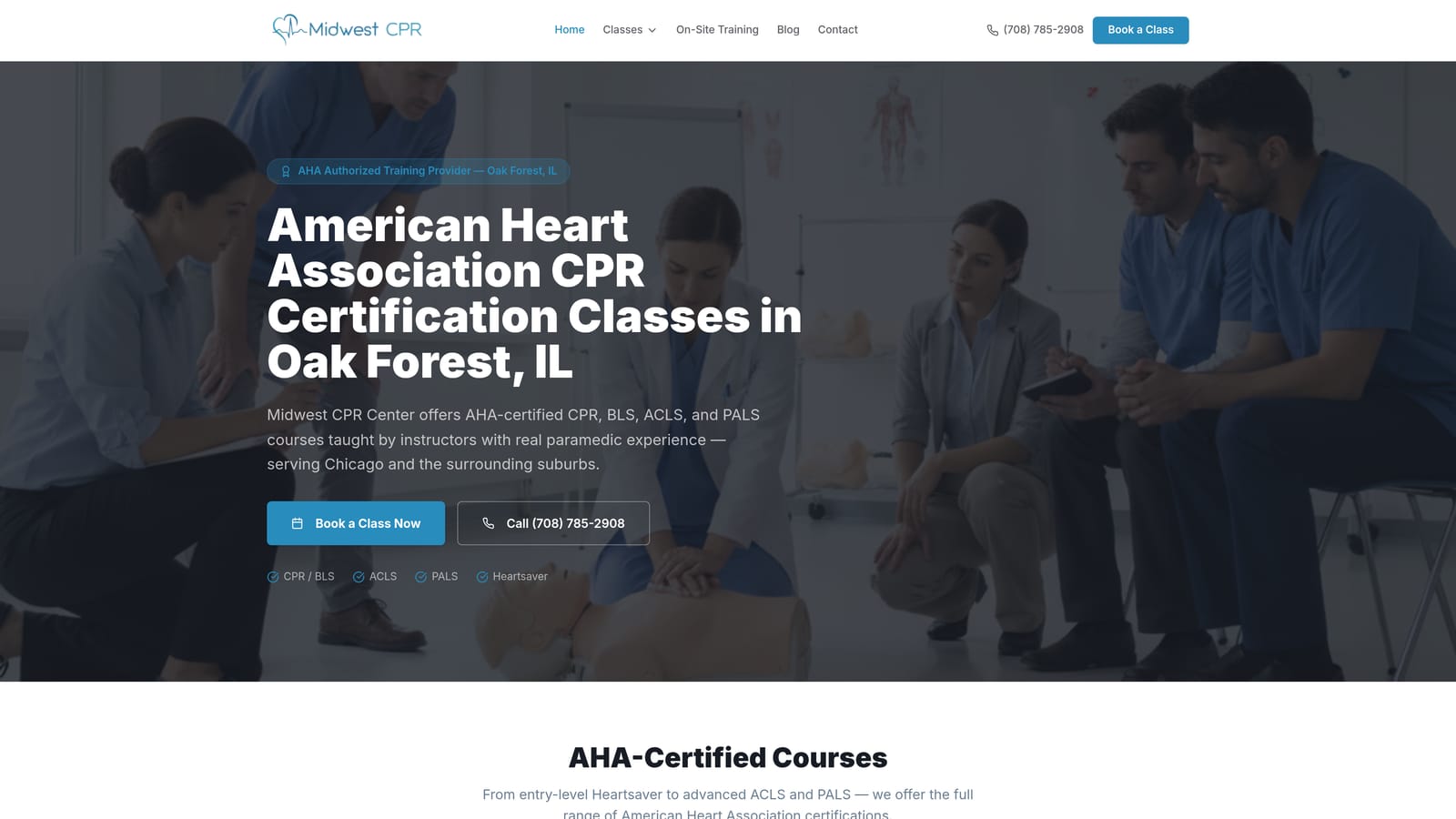
Its distinguishing strength on this list is regional, hands-on medical emergency training. Skills like compression depth and rate are hard to judge through a screen, and an in-person instructor corrects them on the spot. For a daycare team or a small clinic, that matters more than a long course catalog.
- CPR certification courses that teach adult, child, and infant response so staff can act on the people they actually serve.
- First Aid training covering common injuries and sudden illness, useful for workplaces and childcare settings.
- AED training so staff can use a defibrillator (automated external defibrillator, the device that analyzes heart rhythm and delivers a shock when needed) without hesitation.
- BLS (Basic Life Support) certification for healthcare workers and students who need the clinical-level credential.
- Healthcare provider training programs aimed at staff with professional requirements.
There is no software platform to integrate, so setup is a matter of scheduling. Whoever coordinates safety or HR typically books the class. Group and employer booking options should be verified with the center before you plan a team session.
The limitation is scope. Midwest CPR Center covers medical response only. It does not teach fire response, disaster planning, or incident command, and it is not a substitute for a hazard assessment or an emergency action plan. Organizations outside the Midwest will also find the in-person model less practical. Pricing is listed on the company website; it generally depends on the course type, and group arrangements should be confirmed directly.
Best for: Midwest employers, childcare providers, and healthcare staff needing in-person life-saving certification.
2. American Red Cross
The American Red Cross is a national nonprofit that offers First Aid, CPR/AED, BLS, and workplace training in online, blended, and in-person formats. It suits organizations that want a familiar, standardized certificate and one name to point to across multiple sites.
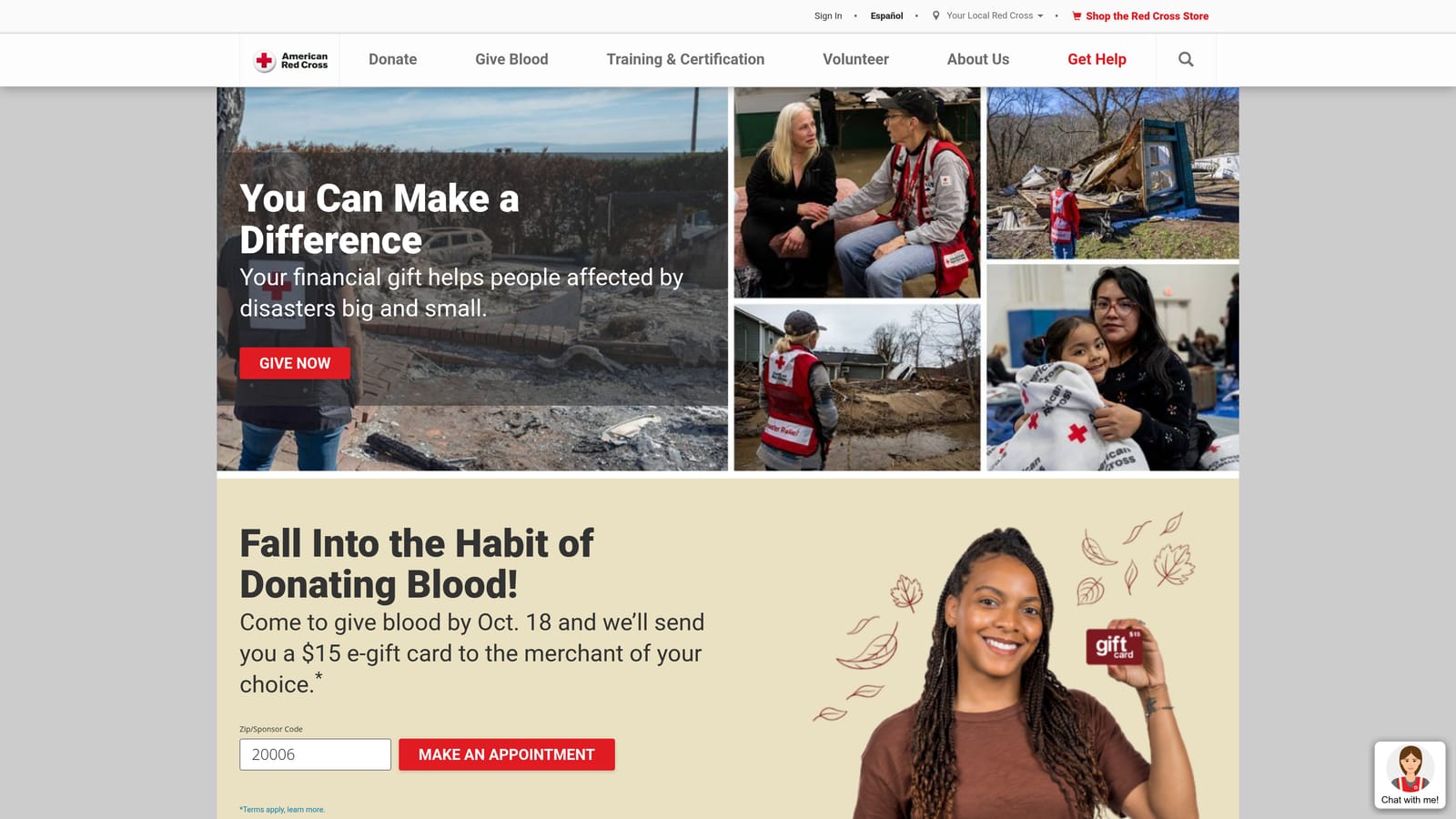
What sets it apart is recognition combined with its role as a disaster-relief organization. Employers and licensing bodies generally know the Red Cross card, which reduces the risk of a certificate being questioned, though acceptance should still be confirmed for regulated roles.
- First Aid, CPR, and AED courses that cover the standard workplace and community response skills.
- BLS for healthcare providers, giving clinical staff a pathway to a professional-level credential.
- Blended learning, where online coursework is paired with a short in-person skills session, saving classroom time.
- Lifeguarding and other workplace programs for organizations with specialized roles.
- A nationwide course finder so multi-location employers can locate sessions near each team.
Employer and group training accounts help manage larger rosters. Setup is light, but the person running it should expect to compare local class availability, since scheduling depends on the area.
The main limitations are variability and flexibility. Pricing and scheduling differ by local provider, and customization of course content is limited. If you need training built around your specific facility, you may find the standard curriculum rigid. Pricing is per course and varies by format and location; as of October 2026, check the website for current rates.
Best for: Organizations wanting nationally recognized, standardized first aid and CPR certificates.
3. American Heart Association
The American Heart Association (AHA) publishes the resuscitation guidelines used across the United States, and its CPR, BLS, ACLS, and PALS courses are taught through authorized Training Centers. Hospitals, clinics, and many licensing bodies specifically ask for AHA-branded cards, which is the reason many healthcare employers start here.
Its clearest advantage over the rest of this list is clinical depth. ACLS (Advanced Cardiovascular Life Support) and PALS (Pediatric Advanced Life Support) go beyond what general workplace providers offer.
What the courses cover
- BLS, ACLS, and PALS for clinicians who need professional resuscitation credentials.
- Heartsaver CPR/AED and First Aid for non-clinical workers such as teachers, coaches, and office staff.
- Blended learning, with eLearning completed first and an in-person skills check afterward.
- An authorized Training Center network so you can find a local instructor or arrange on-site classes.
Practical considerations
Because courses are booked through third-party centers, the experience, schedule, and price differ from one center to the next. The AHA provides the locator and the curriculum, not the classroom. The focus is also narrow: resuscitation, not disaster planning or incident management.
Pricing is set by individual Training Centers, so compare several, and confirm current figures as of October 2026. Someone at your organization will need to handle the booking and track card renewal dates, which are commonly every two years but should be verified for each course.
Best for: Clinical staff and employers whose licensing requires AHA-branded cards.
4. National Safety Council
The National Safety Council (NSC) is a nonprofit safety organization that provides workplace First Aid, CPR, and AED training alongside broader safety programs and consulting. It is built for employers rather than individuals.
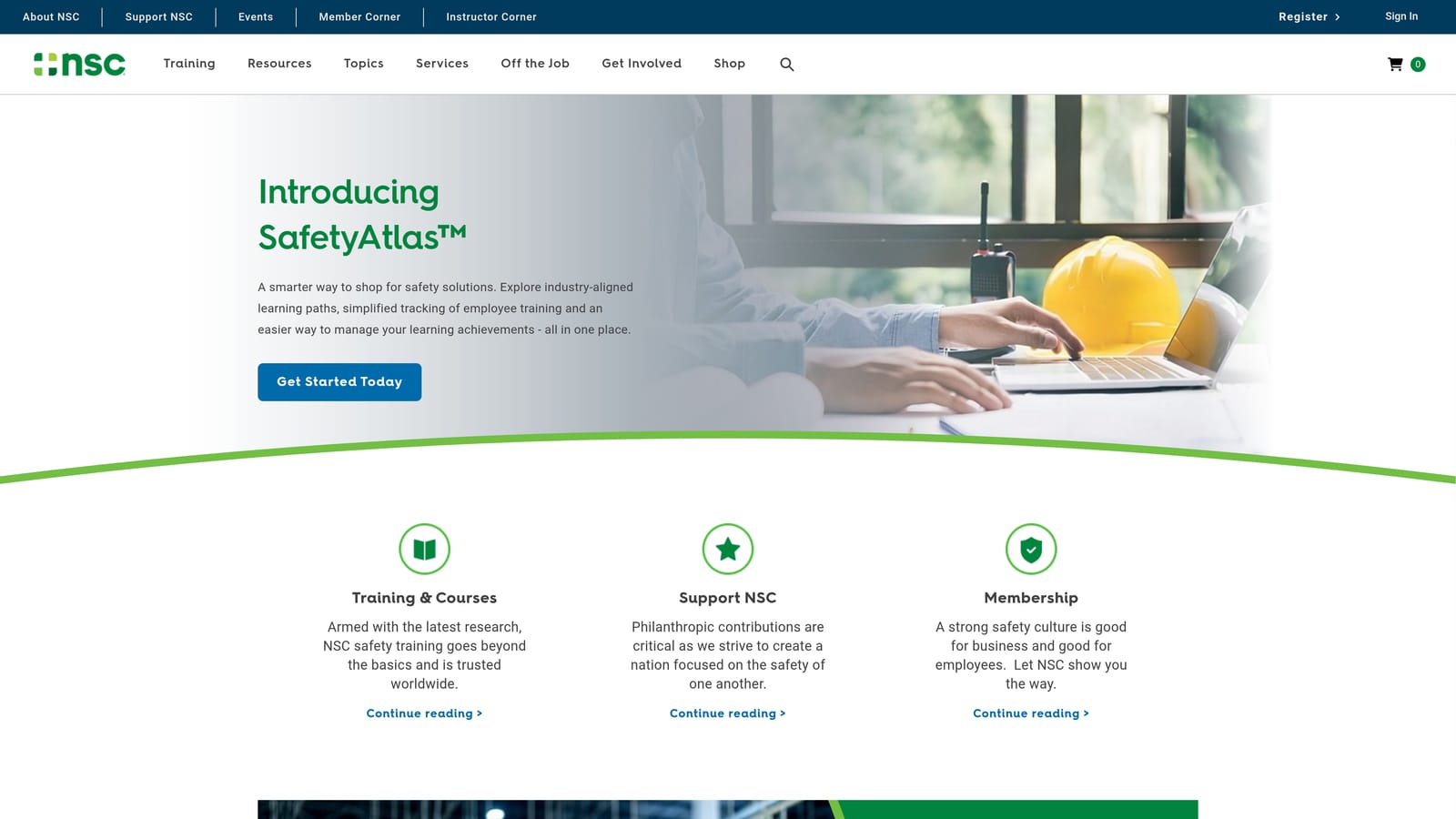
Its distinguishing quality is integration with occupational safety. Where most providers sell a class, NSC places emergency response training inside a wider workplace safety effort, which helps a safety manager connect first aid coverage to hazard reduction, policies, and culture.
- Workplace First Aid, CPR, and AED courses that address the situations employees are likely to face on the job.
- Safety training and consulting that help you look beyond a single course to your overall program.
- Employer-focused programs designed around organizational needs rather than individual enrollment.
- Instructor training options so larger employers can build internal teaching capacity.
Workplace safety program resources support the training, and the natural owner is a safety manager or EHS lead. Expect more planning effort than booking a single class, since the value comes from tying training to your program.
The trade-off is that individuals looking for a quick personal certification will find it a less direct fit. Small organizations that only need a one-time CPR class may not use the broader offerings they would be paying for. Pricing is listed on the website and typically depends on the program and group size; confirm current rates as of October 2026.
Best for: Safety managers building training into a workplace safety program.
5. FEMA Emergency Management Institute
The FEMA Emergency Management Institute is the federal training center that offers free, self-paced Independent Study courses on incident command, community preparedness, and related topics. It addresses a layer the medical providers do not: how to organize a response.
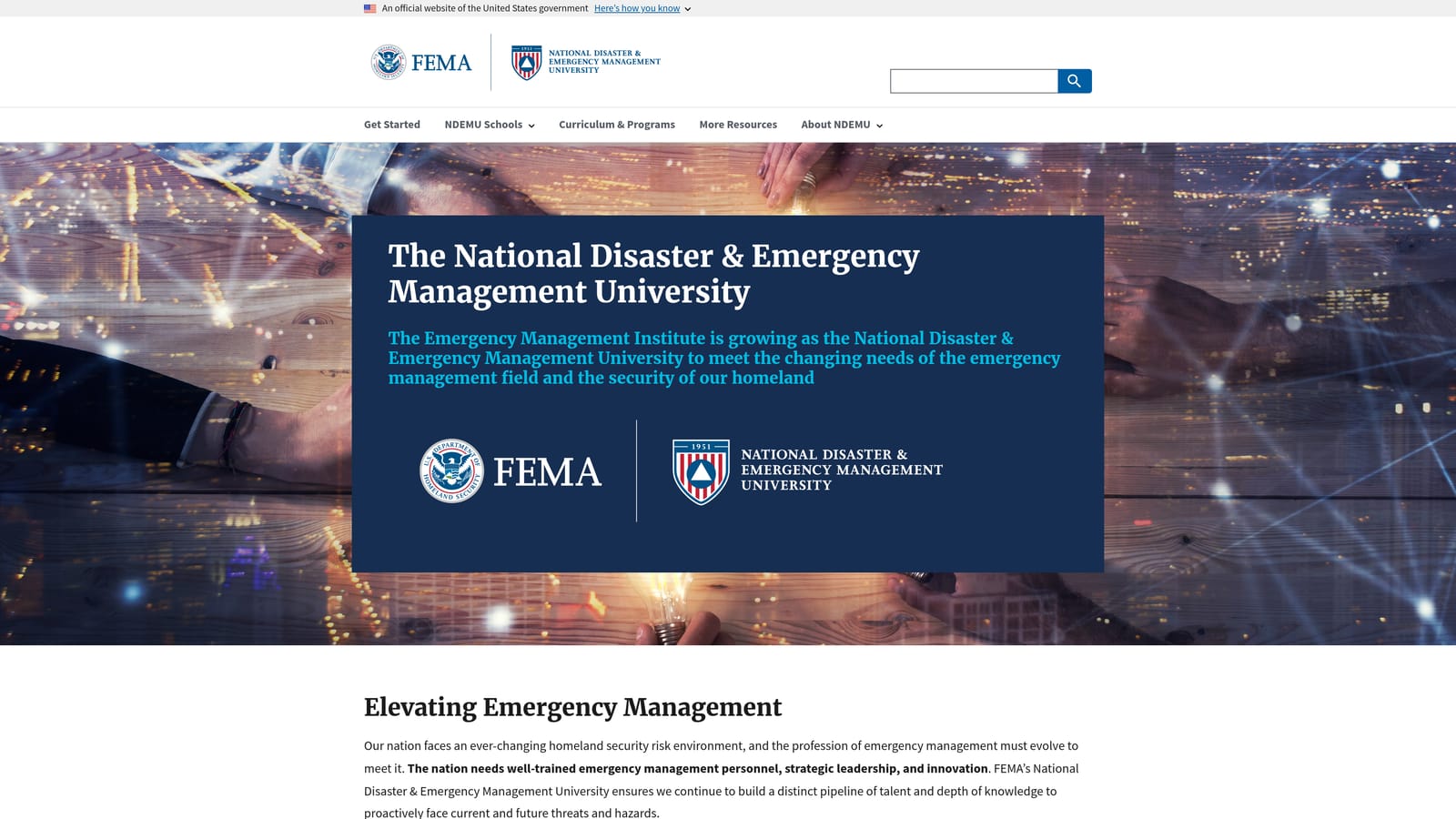
The standout is cost and subject. Government-developed training on incident command and disaster management is available at no charge. IS-100 introduces the Incident Command System (ICS), and IS-700 introduces NIMS, the National Incident Management System, the standard framework agencies use to coordinate responses to incidents of any size.
- Free IS-series online courses that let staff study on their own schedules without a budget request.
- IS-100 and IS-700 to give a shared vocabulary for command structure and coordination.
- Certificates of completion that document who finished which course.
- Resident courses for emergency personnel who need in-depth, in-person instruction.
Students register through the FEMA SID (student identification) system, a quick one-time setup. A planner or facilities lead can usually coordinate it for a team.
Be clear about the limits. There is no hands-on skills training, and the certificates are completion records, not credentials like a CPR card. The courses teach concepts and structure, so they will not prepare anyone to perform compressions or use an AED. They are free for Independent Study courses.
Best for: Planners and responders needing no-cost incident management training.
6. CERT (Community Emergency Response Team) Programs
CERT programs are locally run volunteer trainings that follow FEMA's CERT curriculum. CERT stands for Community Emergency Response Team, and the goal is to teach neighbors to help each other in the hours after a disaster, before professional responders can reach everyone.
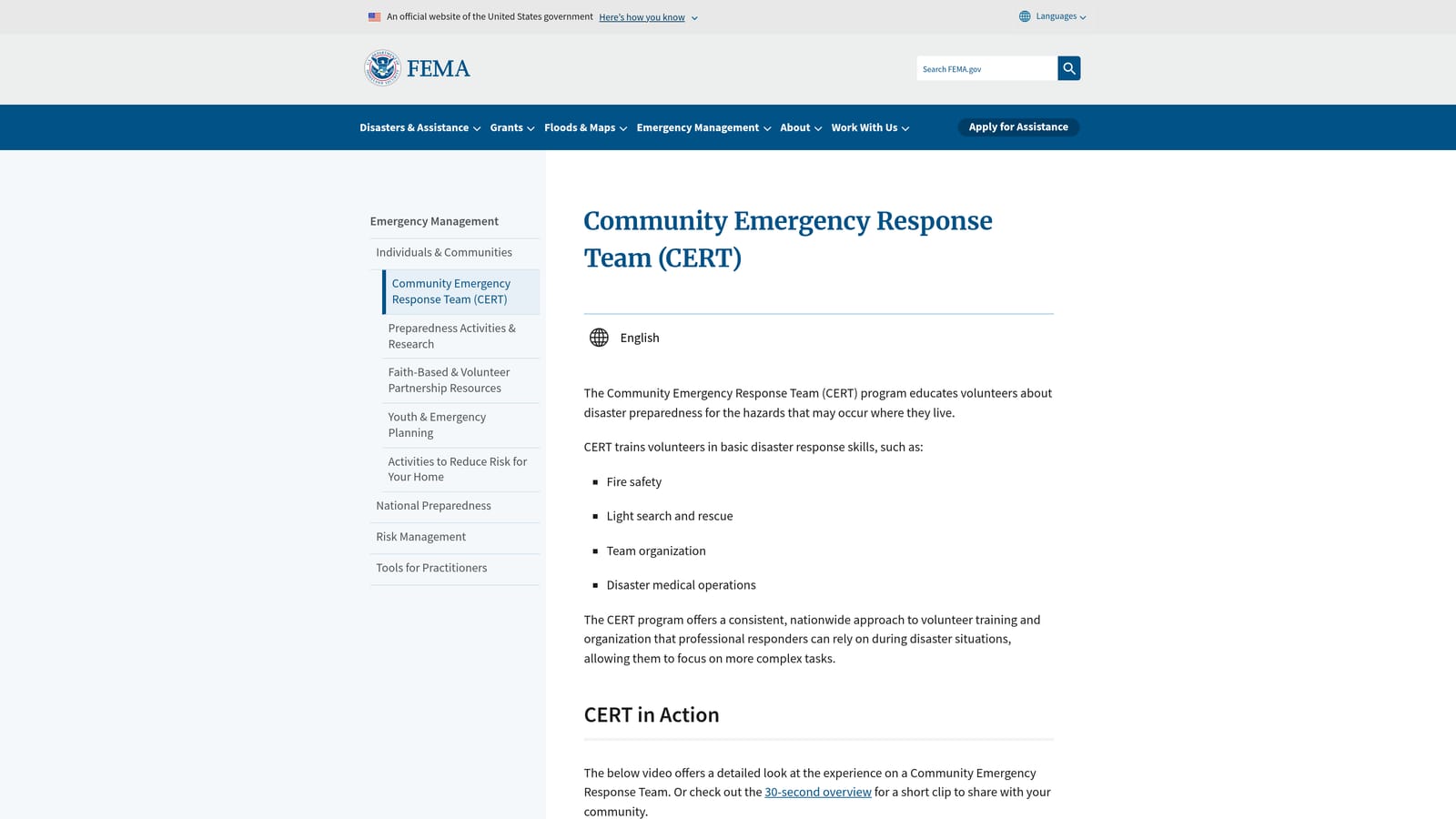
No other provider here builds a trained local volunteer network. The training is delivered by a sponsoring agency, often a fire department or emergency management office, so participants also form relationships with the officials they would work alongside.
- Fire safety and utility control, so volunteers can reduce hazards like small fires and gas or power risks.
- Light search and rescue, teaching safe ways to help trapped people without becoming casualties.
- Disaster medical operations, covering triage and basic treatment when ambulances are delayed.
- Team organization and simulations that let volunteers practice working as a unit.
Programs connect with local emergency management agencies, and setup means finding your area's sponsor and signing up. The main limitation is availability: schedules, class sizes, and whether a program exists nearby depend entirely on the local sponsor. CERT is also volunteer-oriented, so it is not designed to meet employer certification requirements or replace a CPR card.
Programs are typically free or low cost, set by the local sponsor, so verify locally.
Best for: Residents and neighborhood groups preparing for large-scale disasters.
7. ProTrainings
ProTrainings is an online-first provider of CPR, First Aid, and BLS courses, with optional in-person skills verification. It is aimed at organizations with staff spread across locations who need flexibility more than a classroom.
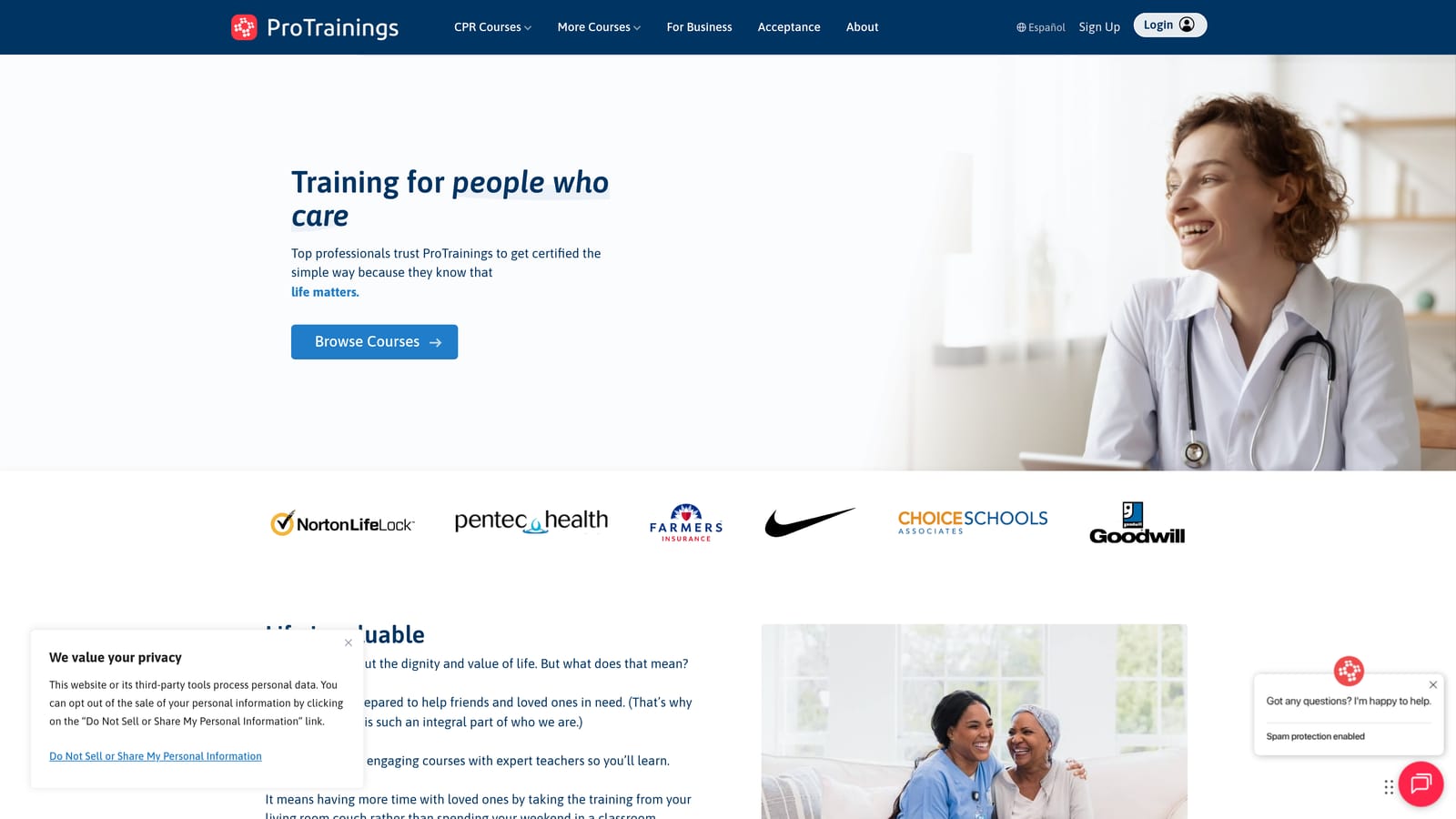
Its edge is the combination of flexible online learning and team tracking. Employees can complete video-based coursework when their schedules allow, while managers see certification status in one place.
- Video-based online courses that employees complete on their own time, reducing scheduling conflicts.
- A blended skills check option, adding hands-on verification for roles that require it.
- BLS and First Aid alongside CPR, so one provider can cover several certification needs.
- Employer account management for assigning courses and monitoring completion.
The organization dashboard tracks staff certificates, so an HR or compliance coordinator can run it day to day without chasing paper cards. Setup is mostly creating the account and enrolling staff.
The limitation to take seriously is acceptance. An online-only card is not accepted by every employer or licensing board, and requirements vary, especially for healthcare roles. Confirm with your regulator or accrediting body before enrolling staff, and use the skills check where in-person practice is expected. Pricing is per course; see the website for current rates as of October 2026.
Best for: Distributed teams needing flexible, trackable certification.
8. ALICE Training Institute
ALICE Training Institute provides active-threat response training for schools, businesses, and other organizations, delivered by certified instructors. ALICE stands for Alert, Lockdown, Inform, Counter, Evacuate, a set of options meant to give people more choices than a lockdown alone.
It is the only specialist on this list for violence-response planning, and it addresses a risk the medical and disaster providers leave untouched.
- The ALICE strategy, which gives staff and students a framework for deciding how to respond.
- Certified instructor programs so an organization can train its own people to lead sessions.
- Drills and scenario training that let people rehearse decisions before they face them.
- Resources for schools and workplaces adapted to those environments.
The training works at the organizational level, feeding into safety plans, so it is usually run by a school safety lead, security director, or administrator working with leadership.
Know the limits before buying. ALICE does not cover medical response or natural disasters, so it cannot be your only provider. Its approach is also debated among school safety experts, so review it with your local law enforcement and school safety partners and consider how drills affect students of different ages. Pricing is quote-based.
Best for: Schools and organizations updating violence-response plans.
Matching Providers to the Gaps in Your Plan
Start with a hazard assessment, because generic training bought without one tends to miss the risks your site actually faces. From there, these pairings hold up well:
- Small employers and childcare: Midwest CPR Center for in-person CPR, First Aid, and AED, particularly in the Midwest.
- Healthcare credentials: the American Heart Association when AHA cards are required, with Midwest CPR Center a local option for BLS and provider training.
- Free disaster planning: FEMA's Independent Study courses for incident command and NIMS.
- Community volunteering: a local CERT program.
- Active-threat readiness: ALICE, reviewed with local safety partners.
Most organizations combine two or three providers, for example medical training, a free FEMA course for the person who writes the plan, and a threat-response program where it applies. Track renewal dates too, since CPR and BLS certifications are commonly valid for two years (verify with each provider). Also check your obligations: OSHA's first aid standard, 29 CFR 1910.151(b), addresses first aid training where no infirmary or clinic is nearby, so confirm the current wording for your workplace.
Don't wait until an emergency happens: equip yourself and your team with life-saving skills today. Schedule your CPR certification class now and gain the confidence to respond when every second counts.